
A small business does not need to become a general-interest publisher to build a useful website. It needs to answer the questions that prevent a suitable customer from making a confident decision. A content calendar helps when it organizes that work. It becomes a distraction when another article is treated as the goal.
Start with questions that repeat
Collect the questions the owner answers in calls and consultations. Remove personal information and look for the decision behind each question. A person asking how much a service costs may need to understand what is included. Someone asking whether you work in their city may need coverage information, rather than an article about that city. Put each question beside the page that should answer it. Some belong on a service page, some in an FAQ and some need a detailed guide. A new blog post is not always the best format. Updating an unclear service description may be more useful than creating a page with an overlapping purpose.
Give each article a useful job
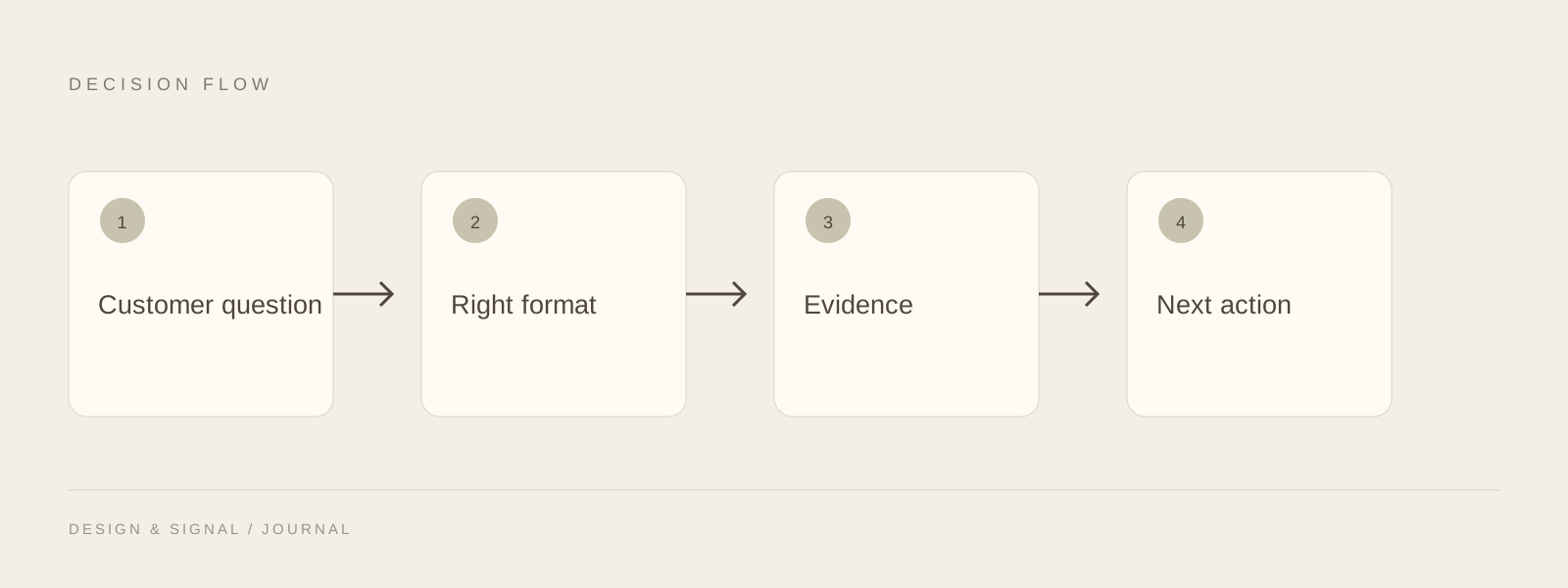
Before writing, record the reader, the decision and the next action. A menu guide might help a restaurant prepare materials for a rebuild. A bilingual website guide might help an owner choose a maintenance workflow. These are concrete purposes that can be evaluated without predicting a ranking. Google’s people-first guidance emphasizes original value, clear sourcing and a satisfying answer. It also warns against producing large amounts of content primarily for search visits. We use that as a review direction, not a required word count or a recipe for guaranteed visibility.
Separate evidence from advice
A recommendation can be explained as a design judgment. A numerical claim, platform rule or result needs an appropriate source. Link to original documentation and record when it was checked. Do not turn an anecdote into a universal conversion statistic. When discussing our work, distinguish what was built from a concept or planned integration. AI can assist a draft, but editorial review still checks facts, links and usefulness. A polished paragraph is not evidence by itself.
Connect the article to the service journey
A reader should not reach a dead end. Link naturally to a relevant service, an example and another useful guide. Avoid repeating a sales button after every paragraph. A clear final action and a small set of meaningful links make the path easier to understand. Use an honest service-area brief for a location question. Use a labeled interactive concept for a practical example. Do not invent customer stories merely to create more internal links.
Review before adding more
Record publication, substantive updates, sources and the next reason to review. Changing the date alone does not improve the answer. After launch, compare actual search questions and relevant enquiries with the page’s purpose. Observations guide improvement but do not establish causation alone. The purpose of the content system is to make this work maintainable. Drafts can be kept out of public pages, source references remain attached to the article, and a small content ledger records what should be reviewed next. Start with a maintained collection and expand when a new question deserves its own answer.
Choose the format after you understand the decision
A repeated question does not automatically deserve a blog post. First ask what the customer is trying to decide. If the answer belongs on a service page, improve that page. If the question is narrow and recurring, an FAQ may be enough. If the answer needs trade-offs, examples or sources, a guide may justify its own URL.
This prevents a common content mistake: using the blog as storage for information that should have been part of the buying journey. A website can publish regularly and still become harder to navigate if the core service pages remain vague.
Publishing another article is not the only way to improve an answer.
- What is included and is it suitable?
- Put decisive buying facts here
- A narrow, recurring uncertainty
- Answer without unnecessary expansion
- A choice needs evidence and tradeoffs
- Use examples and explain limitations
Use an evidence ladder
Not every sentence needs a citation, but different claims need different support. Platform rules should point to current platform documentation. Numerical outcomes should identify the study, population or case context. First-hand business facts should come from the business owner or operating system. Design recommendations can be presented as our judgment, with the reasoning made visible.
Google’s people-first content guidance asks whether content demonstrates first-hand expertise, has a clear purpose and leaves the reader feeling they learned enough to achieve their goal. We use those questions as editorial prompts rather than a secret ranking checklist.
Refresh, merge or retire instead of endlessly adding
A content program needs subtraction. Review whether two articles now answer the same question, whether a service has changed, and whether an old page still deserves internal links. If a newer deep guide supersedes a short article, the short article can become a concise primer that links forward rather than competing with it.
Changing the publication date without a substantive update is not maintenance. Record what changed, which sources were rechecked and whether the reader’s decision changed. When an article no longer has a distinct job, merge or redirect it instead of keeping it alive for historical page count.
Use AI for draft leverage, not evidence replacement
AI can help organize notes, propose outlines and produce a first draft. It cannot confirm whether a business serves a neighbourhood, whether a price is current or whether a study applies to this client’s market. Those facts require an accountable source.
Our editorial workflow keeps drafts private, attaches sources, separates writer and approval permissions, and builds the site only after review. The system is useful because it makes publishing repeatable; it does not make every generated paragraph true.
For a deeper look at how content may surface in AI-assisted search, read the GEO research guide. For multilingual operations, the bilingual content system guide covers shared facts, review and release in more detail.