
A visible language switch is useful only if the page behind it is useful. For a small business, the difficult part of a bilingual website is often maintenance: a service changes, the English page is updated, and the Chinese page quietly keeps the old information. A good structure should make that disagreement harder to create and easier to notice.
Share facts, not necessarily sentences
Keep prices, hours, contact details and service identifiers in a common record where possible. The wording around them can differ between languages because natural communication is not always sentence-for-sentence translation. A short English headline may need a different Chinese layout, and a service name may require explanation rather than a literal translation.
Decide who can approve the business facts in each version. Automatic translation can help produce a draft, but a person still needs to review price conditions, cancellation rules and statements about services. Do not let one language become the unofficial place where important exceptions are hidden.
Give each version a stable address
Google documents how language annotations can identify equivalent localized pages. For our bilingual architecture, the English and Chinese versions have their own URLs, and each points to the corresponding alternative. The visible switch follows the same page rather than returning every visitor to the homepage.
A canonical address and a language alternative do different jobs. The publishing workflow should generate both deliberately rather than treating every translated page as a duplicate to discard. Our website keeps existing guide URLs in place while the new journal follows the same language structure. Detailed implementation should be checked against current official guidance, not a copied snippet from an unrelated site.
Separate language from currency and location
Reading Chinese does not mean a customer is in China. Reading English does not mean a customer wants USD. Keep the choices independent, show what is selected and let the visitor change either. Region detection can suggest a currency, but a manual selection should not be overwritten by a slow network response.
For an enquiry, carry the chosen currency and package into the next step. When a language link changes the URL, preserve the useful selection without copying personal information into the address bar. Names, email addresses and free-text requirements do not belong in shareable query strings.
Publish changes as a small release
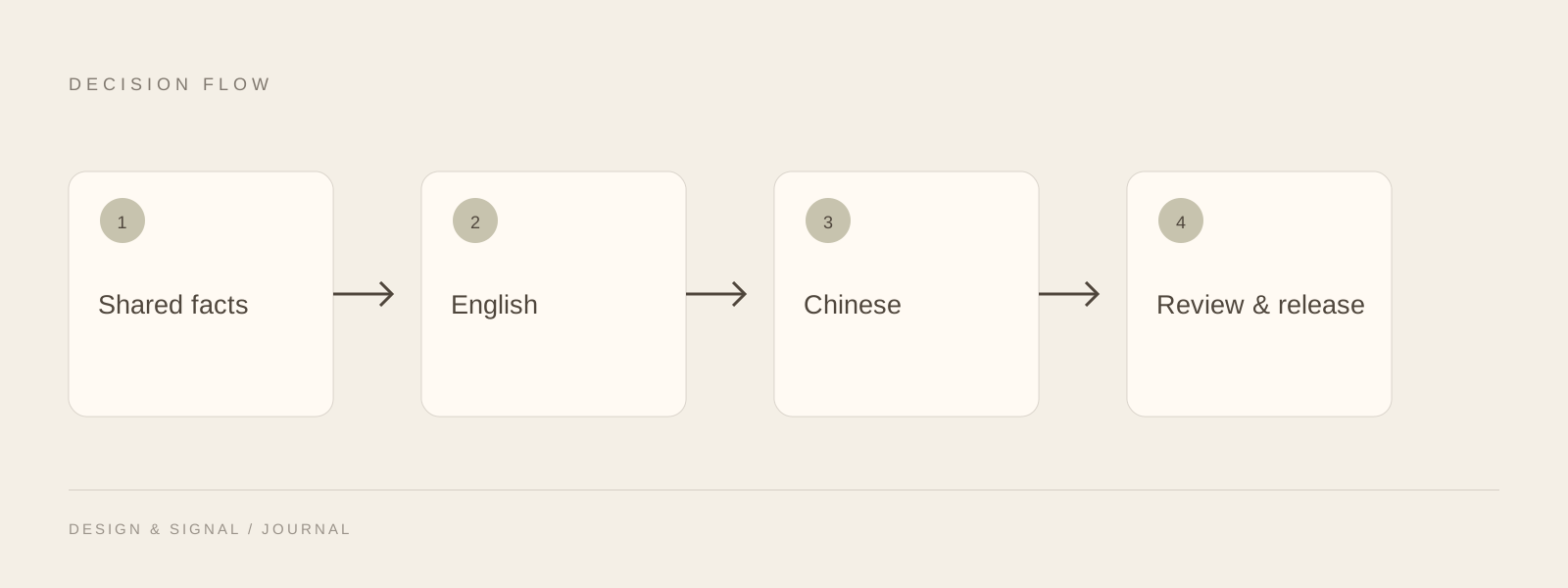
Treat a content update as a set of related changes rather than isolated text boxes. List affected pages, update the shared facts, review both languages, test the mobile layout and verify the booking or contact destination. Keep a short record of what changed and who approved it.
Start with a manageable amount of content. It is better to maintain a few complete service pages than to translate dozens of pages nobody reviews. Our current journal requires both language versions before a post can be published; drafts stay outside public routes and feeds. That is an editorial safeguard, not a claim that every site must use the same rule.
Make the handover understandable
A business owner should know which fields can be edited safely, where the second language lives and what needs review before publishing. Demonstrate a realistic task, such as changing an opening time or correcting a service description. A handover is successful when the owner can repeat the task without guessing, not merely when a login has been provided.
Treat language metadata as part of publishing
The visible switch is only one part of a multilingual site. Each page should declare its language correctly, and equivalent language versions need a stable relationship. Google documents hreflang as one way to identify localized alternatives, while W3C guidance explains why declaring the language of the page matters to user agents and assistive technology.
The operational lesson is not to memorize a snippet. It is to generate these relationships from the same route and content model that publishes the pages. If someone can accidentally add a Chinese page without its English partner, or change one URL without the alternate link, the process is too fragile.
Separate shared facts from localized judgment
Some information should be identical across languages: opening hours, package identifiers, an approved price, a booking URL. Other information benefits from localization: the order in which a service is explained, examples, terminology and tone. Mixing these categories makes review difficult.
Create a small shared-facts layer and let each language write around it. When a fact changes, the system can identify both affected pages. When the wording changes, each language reviewer can judge naturalness without rewriting the business rules.
Natural writing can differ without changing the business promise.
- Approved price and service identifier
- Current hours and booking destination
- Scope and real policy conditions
- Clear terminology and explanatory order
- Examples the reader can understand
- Natural wording with the same qualifications
Know when a regional variant is actually different
Language and region are not interchangeable. An English page for Canada and an English page for the US may share most text while differing in currency, tax language, shipping or service scope. Google’s guidance on locale-adaptive and multiregional sites is a reminder to make regional behavior explicit rather than assuming browser language is a reliable market signal.
Do not create regional variants unless the offer really changes. More URLs create more things to maintain. A manual currency selector can coexist with one English article; a legally different service offer may justify a separate regional page.
Design the release and rollback before the content volume grows
A bilingual workflow becomes expensive when a small update requires remembering dozens of places. Define a release unit: shared fact change, English review, Chinese review, link check, mobile check and final approval. Keep the previous public version available until the new build succeeds.
Our longer bilingual content operations guide describes the API, approval and release model in more depth. This shorter article has a simpler purpose: make sure a small-business owner understands that the hard part is not the language switch itself. It is keeping two public versions true over time.