
A service-area page should help someone decide whether a business can actually help them. A city name in a heading is not enough. The page needs to explain the service relationship, what changes because of the location and how to take the next step. For a small studio, a few carefully considered pages are a better starting point than a map full of unverified claims.
Separate where you work from where you have an office
A business can offer remote services to a city without having premises there. Say which relationship applies. Do not add a street address, opening hours or a map pin merely because a template has a space for one. Google Business Profile has eligibility and representation rules; a website service-area page does not automatically establish eligibility for a local listing.
Our service areas explain how we approach work for nearby businesses without presenting them as separate studio offices. In-person visits are not promised by default. This is a practical boundary that helps a prospective client understand the service before contacting us.
Make the local page answer a different question
Begin with the actual customer situation. For a bilingual restaurant, the useful discussion might be maintaining an English and Chinese menu, keeping prices consistent and making private dining enquiries easy. For an appointment-led business, it may be service descriptions, the handoff to an existing booking tool and information needed before a visit.
These are planning scenarios, not claims that every business in a city has the same needs. Ask the owner what customers actually ask. If the answers are identical across ten proposed city pages, a single well-organized service page may be more useful. A separate URL should earn its place through information, not the possibility of another keyword combination.
Use evidence you can keep current
A genuine local case can explain the brief, constraints, decisions and results you are allowed to share. Without that permission or evidence, use a clearly labeled concept rather than inventing a client name or a performance figure. Photographs of a city do not establish that a project happened there.
Useful supporting material could include approved visiting instructions, real service coverage, a customer question answered in detail or an actual delivery example. Record where each factual claim came from and who can update it. Avoid implying that remote availability creates an office, staff member or professional accreditation in the area.
Build a small publishing gate
Before creating a new page, document its purpose, the distinct information it adds and the relationship between it and the main service page. Check internal links, the visible contact path and any structured data. The data should describe what the page actually says, not embellish it with an invented address or rating.
Google’s spam policies discuss doorway abuse and large-scale low-value content. The practical lesson for this project is not to publish a matrix of city and industry names with interchangeable paragraphs. Our content ledger asks for a reason and supporting material before expanding the location set.
Measure useful enquiries, not page count
A location page can be reviewed through verified impressions, visits and relevant enquiries after launch. Keep the limits of each metric visible. No page structure guarantees local ranking or inclusion in an AI answer. When the evidence is weak, improve the answer and service clarity before adding more pages.
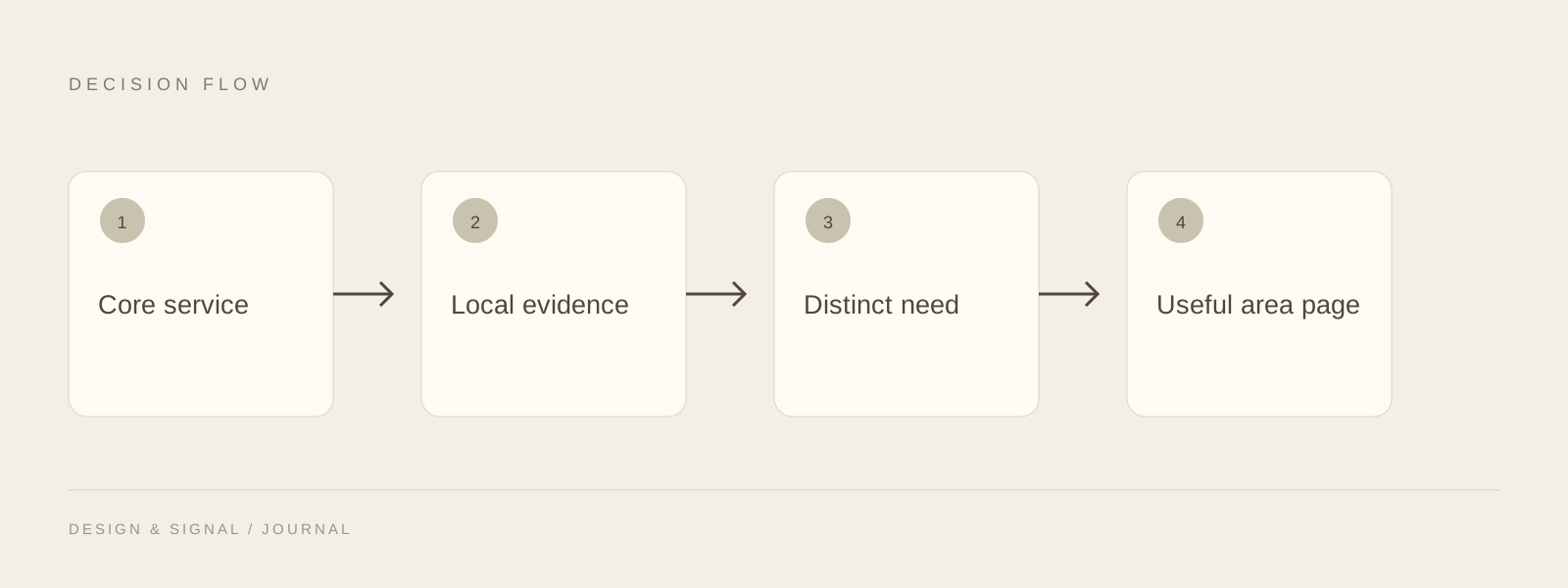
Use a decision gate before creating another URL
Before a city page exists, write down the customer question it will answer and the evidence that makes the answer local. If the proposed page only changes the place name, it has not earned a separate URL. If the service rules, visiting information, travel conditions, language needs or examples genuinely differ, a separate page may become useful.
This decision gate is intentionally stricter than a keyword spreadsheet. Google Search’s spam policies describe doorway abuse and scaled low-value content as patterns to avoid. That does not mean every service-area page is spam. It means the page needs a user-facing reason beyond capturing another query variation.
Keep Business Profile eligibility separate from website architecture
A website can explain that a business serves Markham or Richmond Hill without proving that it is eligible for a Google Business Profile at a particular address. Google’s representation guidelines define separate requirements for real-world business presence and service-area businesses. Do not let a web page invent a storefront, staffed office or opening hours to make a local strategy look stronger.
Likewise, a valid Business Profile does not automatically justify a city landing page. Profile eligibility and website information architecture are related but different decisions.
A useful webpage does not establish a staffed location or an eligible business profile.
- Check the real service model
- Follow the applicable representation rules
- Do not invent customer-facing premises
- Identify a distinct customer question
- Explain verified local differences
- Use the shared service page when unchanged
Use a regional hub when several cities share the same service
A GTA-wide business may need one strong service explanation plus a regional overview, with city pages only where there is distinct information. This keeps shared facts in one place and reduces the chance that prices, promises or policies drift between nearly identical pages.
Our GTA website primer shows that structure at a higher level, while the Richmond Hill and Markham local SEO guide goes deeper into profile eligibility, bilingual context and enquiry measurement.
Measure whether the page answers the intended question
A useful review does not stop at impressions. Check whether the page receives relevant visits, whether people reach the intended service or enquiry path, and whether the resulting questions match the purpose of the page. Google describes relevance, distance and prominence as important local ranking factors; an agency cannot remove the distance component or guarantee a local placement.
If the page attracts traffic but produces confused enquiries, improve the service explanation before adding another city. If the page receives no meaningful visibility, revisit whether the local question exists and whether the business has enough evidence to answer it. Page count is not the objective.