
A wider service area does not have to mean a larger collection of near-identical pages. Our starting point for a business working across the Greater Toronto Area is one clear source for its services, then a deliberate place for information that really differs. This is a planning approach, not a claim that we have delivered a particular local client result.
Start with the actual service boundary
Before writing a regional page, ask what the business can genuinely provide and where. Does the customer visit a premises, receive an on-site service, or work remotely with the team? Are there differences in travel arrangements or availability? These answers should come from the business owner, rather than from a list of place names selected for search traffic.
A service-area statement is not an office address. A business that serves Markham and Richmond Hill should not imply that it has a walk-in location in either city unless that is true. The website should explain the relationship in plain language. When a detail is still undecided, leave it for confirmation rather than inventing an address or an impressive-looking map.
Keep shared facts in one place
Services, standard prices, contact details and core policies usually benefit from a common source. Copying them into many pages creates more places for an old price or outdated phone number to survive. A single service description can be linked from different regional contexts without being rewritten each time.
Consider a hypothetical team offering the same website service across the GTA. The main service page explains the deliverables and what is outside the quote. A regional overview explains how collaboration works across the service area. A city-specific page is added only when there is useful, confirmed information that belongs there. This structure makes the maintenance obligation visible before the site grows.
Separate articles from service pages
A service page helps someone decide whether to enquire. An article helps them understand a question. Those are related purposes, but they are not interchangeable. A practical guide to managing a bilingual website belongs at a stable article URL. It can be discovered through a topic, industry or regional collection without creating three copies of the body.
In our journal, a GTA collection can include an article explicitly tagged to Markham or Richmond Hill. The reverse is not automatic: a broad GTA article does not suddenly become a city-specific article. Geographic tags are editorial context, not a claim about offices, customers or results. Add a city tag because the article genuinely addresses that context, not because the tag is available.
Discovery collections organise reading; the service page explains the actual offer.
- One stable address per language
- One maintained explanation
- City stories can roll up to GTA
- Collections do not copy the body
- Scope and genuine coverage
- Not a fictional local office
Give each new local page a reason to exist
Useful differences might include an approved visiting instruction, a service boundary, a genuine local project or a question that needs a different answer. A changed heading alone is not enough. Google’s spam policies discuss doorway pages, including substantially similar pages aimed at closely related search queries. The practical response is not to hide repetition better; it is to make each page useful on its own.
When there is no distinct article for a city yet, a collection can say so honestly and direct the reader to the broader library. We keep empty collections out of the sitemap and do not treat them as search landing pages. The service proposal can still explain what is available without padding the article list with invented expertise.
Make publishing a repeatable review
Before release, check the service scope, facts, source links and the corresponding language version. Keep the original publication date and change the update date when the content actually changes. An automated writer can prepare a draft, but saving that draft should not silently publish it.
A useful sequence is draft, validation, review, approval of that exact version, then a recorded website build. If the draft changes after approval, review the new version. This is as relevant to a regional article as it is to the business’s service pages: consistency comes from the publishing process, not simply from the number of pages produced.
For a service overview, see how we work across the GTA. For a related planning question, read why an area page needs a purpose.
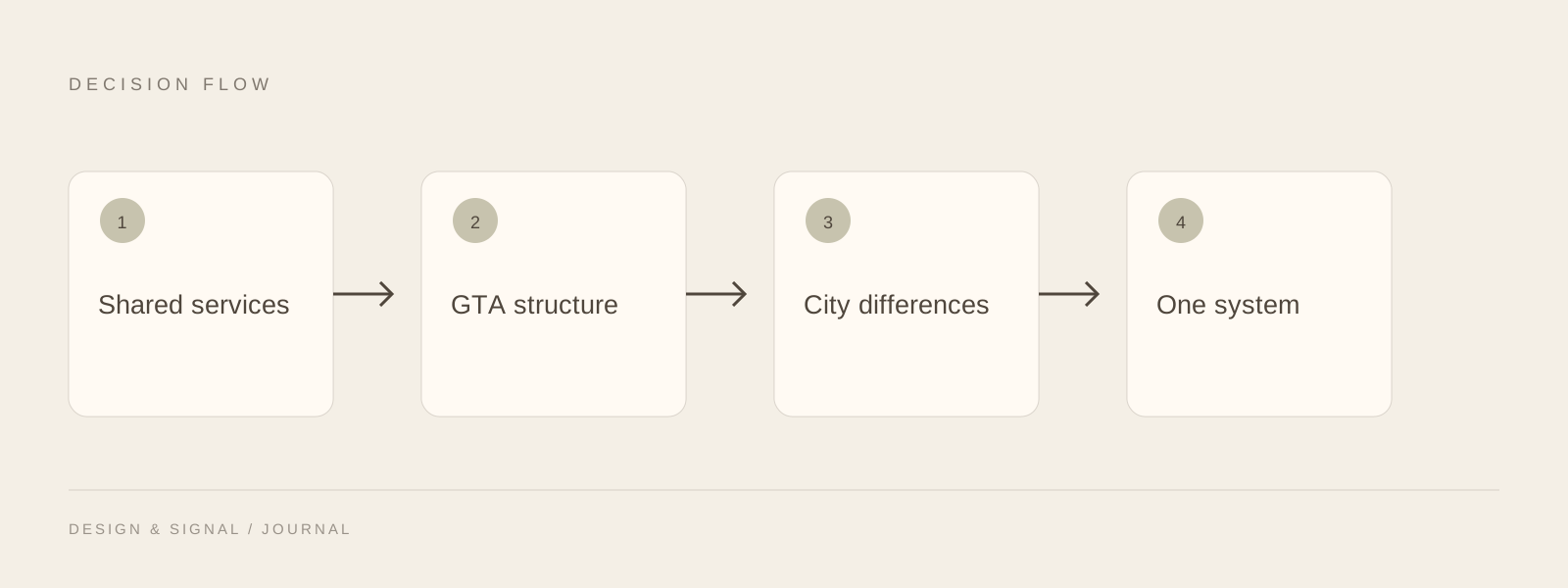
Keep the shared facts above the geography
A business serving several GTA municipalities still has one core offer. Put shared service scope, pricing logic, exclusions and contact behavior in a maintained source instead of copying them into every city page. Geography should add context, not fork the business into several slightly different versions.
A regional hub can explain the overall service model and help people navigate to information that genuinely differs. It also gives the editorial team a place to collect regional articles without pretending those articles are office locations.
Promote a city page only when the city changes the answer
A Markham page should exist because Markham changes something useful: a real office, a service rule, a delivery pattern, language context, a case the business can publish, or a recurring question that needs its own answer. If none of those are true, a city archive or regional article may be the better format.
Google’s spam policies are relevant because large sets of near-identical location pages can become doorway-like or low-value. Google’s local ranking guidance is also a reminder that website copy cannot erase distance. A page should explain the business honestly, not try to simulate physical proximity.
Use this primer as the architecture map
The detailed Richmond Hill and Markham local SEO guide covers profile eligibility, page architecture, bilingual context and measurement. This shorter GTA article serves as the map: keep shared facts centralized, create regional reading where it is useful, and let city pages exist only when the local difference can be maintained.